Lane Kiffin: The Lost Boy of the SEC
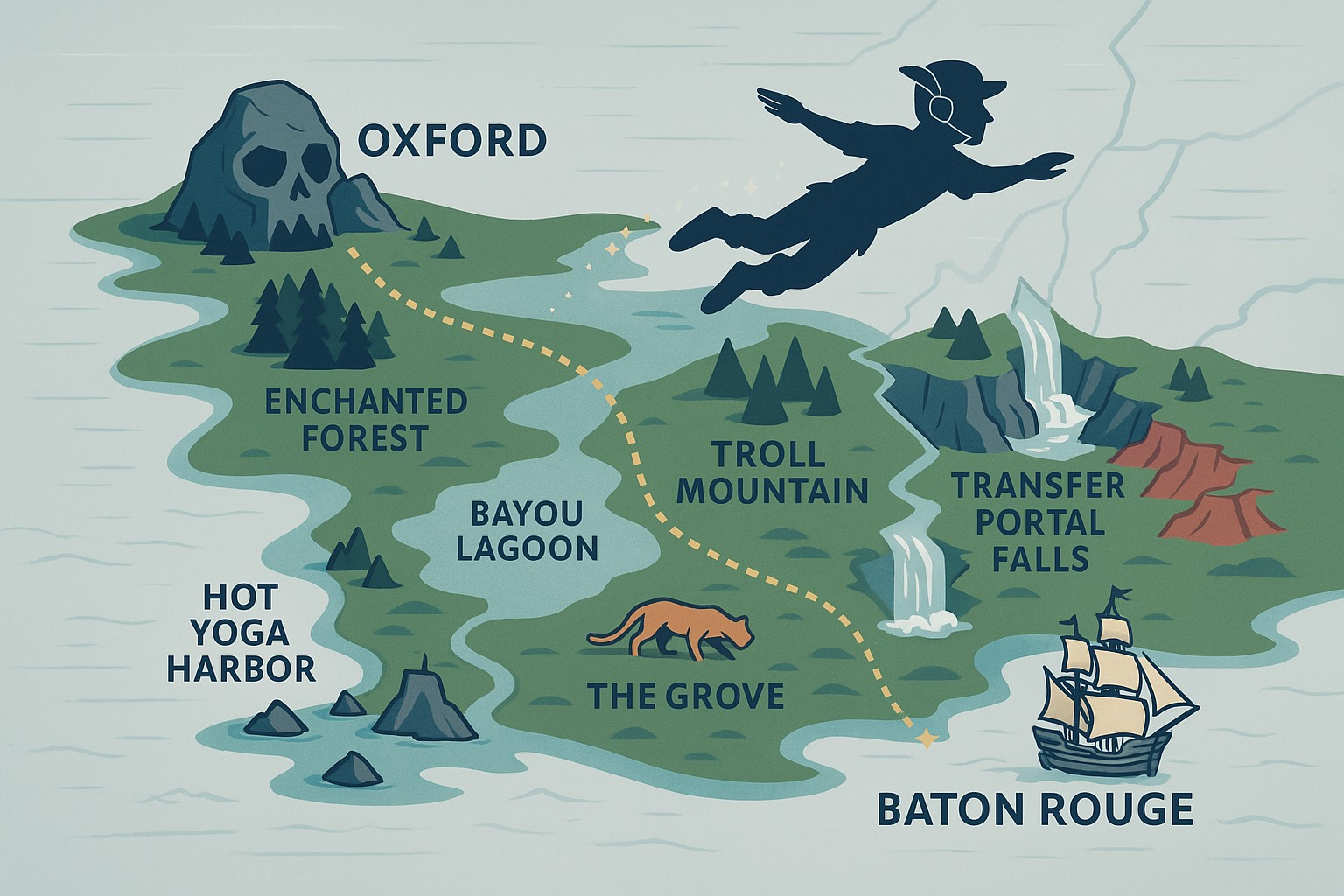
Oxford woke up the morning after Lane Kiffin’s departure feeling hungover in ways that had nothing to do with bourbon. For six seasons, Ole Miss football fans were bedazzled by the high-flying, pixie dust coated magic of college coaching's Peter Pan.
Lane Kiffin came to the Velvet Ditch like Peter Pan dropping into the nursery, bright-eyed and mischievous, promising adventure. He was the boy who refused to grow up, and in a sport built on fathers and sons, inheritances and legacies, that made him irresistible. He spoke in jokes. He tweeted like a teenager. He won. And this town, this place where story is sacrament — convinced itself that this time would be different. That this time the man-child would choose to stay. But belief is a dangerous currency, especially when you invest it in someone who never intended to stay.
Peter Pan is always looking for the open window.
THE EXIT WOUND
Kiffin’s departure for LSU wasn’t a clean break, because nothing involving him ever is. It was clumsy and messy and avoidable. He flirted, denied, hinted, denied again. Boosters scrambled. Players whispered. Assistants quietly updated résumés like people grabbing valuables during a house fire.
By the time the truth landed — Lane Kiffin to LSU — Oxford didn’t react with shock so much as exhaustion.
Kiffin’s genius, and his curse, is that he has always existed slightly adjacent to responsibility. He is the gifted child forever protected by the glow of potential. The next big thing, even when he was supposed to already be the big thing. The Raiders, Tennessee, USC - every stop ended with the same bewildered wakefulness, the sudden realization that fun and brilliance and chaos are not a sustainable ecosystem.
He has always carried the baggage of his own mythology, each stop on his winding odyssey marked by equal parts brilliance and calamity. First there was Oakland, where a restless owner and a restless prodigy collided in a brief, combustible marriage that ended before either understood what had happened. Then came Knoxville. Tennessee fans still haven’t fully forgiven him for that midnight escape, a single year punctuated by sirens wailing across campus as word spread that their boy wonder had slipped out a side door and into a waiting SUV. Finally at USC, all of his missteps metastasized — the tarmac firing at LAX, a scene so cinematic and humiliating it came to define him for years. Everywhere he went, Lane Kiffin left emotional shrapnel, small pieces of himself embedded in places he swore he meant to stay.
Oxford, though, became something else entirely. It was never just a job; it was a rehab of the soul, a soft place to land after a decade of pratfalls and public unraveling. People there watched him take hot yoga classes, drop weight, get sober, and begin speaking in the language of self-improvement. He traded late-night chaos for early-morning routines. He smiled more easily, lingered in conversations, seemed lighter somehow. For the first time, it looked as though the boy who never grew up was finally trying.
Oxford didn’t just believe in the renaissance — it nurtured it, fed it, prayed it into being. The town became convinced it had helped Lane Kiffin become an adult. And maybe that was the seduction. Because believing he’d finally grown up made it hurt more when he reminded everyone that Peter Pan always finds the open window.
RIVALRY AND BETRAYAL
Leaving is one thing. Leaving for LSU is another.
Ole Miss didn’t just lose a coach; it lost him to a neighbor it’s been quietly resenting for a century. The two schools know each other too well, like cousins raised too close, separated only by a long stretch of I-55 and a long history of trying to prove who belongs more.
These are fan bases who share recruiting territories and fight over the same kids in the Delta, and trade stories about the nights in Baton Rouge that went sideways. It's Billy Cannon's Halloween run, The Night The Clock Stopped, it's 100-plus years of not liking each other. The Ole Miss–LSU rivalry isn’t loud like a lot of its SEC rivalry counterparts. It’s subtler, older, pettier — a long simmer rather than a boil. A rivalry built on border towns, bourbon, and bruised pride.
So Ole Miss wakes up to find its former coach wrapped in purple and gold, selling the same grin, the same jokes, the same pixie-dust offense to a fan base that once snarled at him from Baton Rouge balconies. The same people who mocked his Ole Miss quirks now welcome him as their own. The same LSU diehards who told him Oxford was "cute" now insist he’s their missing piece.
For Rebels fans, this betrayal hits every raw nerve. LSU is the louder, brasher cousin who never seems to doubt itself. They have the stadium that shakes, the tailgates that never end, the bankroll that never quite empties. Ole Miss has charm, heart, history — and an eternal chip on its shoulder. Losing Kiffin to anyone would’ve stung. Losing him there, to the place that never lets you forget who won more, ate better, and partied harder? That’s salt in the wound.
THE AFTERMATH
There’s a particular kind of quiet that falls over a college town after a coach leaves — not grief, exactly, but vacancy.
But here’s the secret: Ole Miss will be fine. This place has lived through real loss. It knows how to bury a bad year, how to heal from a messy departure, how to rediscover its voice. Ole Miss has fostered its fair share of legends, but it does not depend on them.
Kiffin, though, he continues forward, the eternal wunderkind chasing the next thrill. LSU is the newest playground, full of shiny toys, willing believers, and enough resources to make the game feel effortless. For a while, he will dazzle. He always does.
And then? Who knows. But every story about Peter Pan ends the same way: the boy flies off, and the people left behind try to remember that space between real and make believe.
In the end, Lane Kiffin remains what he has always been — a brilliant mind wrapped in just enough mischief to make believers out of grown men. He is a gifted play caller, a performance artist, a chaos merchant who treats adulthood like an optional assignment. His greatest opponent has never been a defensive coordinator; it has always been the idea of growing up.
Maybe LSU thinks it can be the place that tames him, the place where the boy finally gives way to the man. Maybe they believe the lights of Tiger Stadium and the roar of Saturday nights will hold him in place. Lane Kiffin's receipts provide plenty of doubt. The boy doesn’t settle. The boy grows restless. And when the wind shifts, the boy flies.
Ole Miss didn’t lose a coach. It woke up from a fairy tale it desperately wanted to be true.